No machine drivers
No node-pool provisioning and no forced infrastructure workflow.
ASTRONOMER PRODUCT / PLATFORM
Astronomer is the operating layer after a cluster exists. Adopt it, standardize it, deliver to it, operate it and govern it from one console, one API and one audit trail, while each cluster keeps running on its own.
Alpha · Self-hosted · Defaults and limits listed with each feature01 / PRODUCT AREAS
Select an area to see its screen and the specifics. Fleet, delivery, governance, security and operations each have their own page.
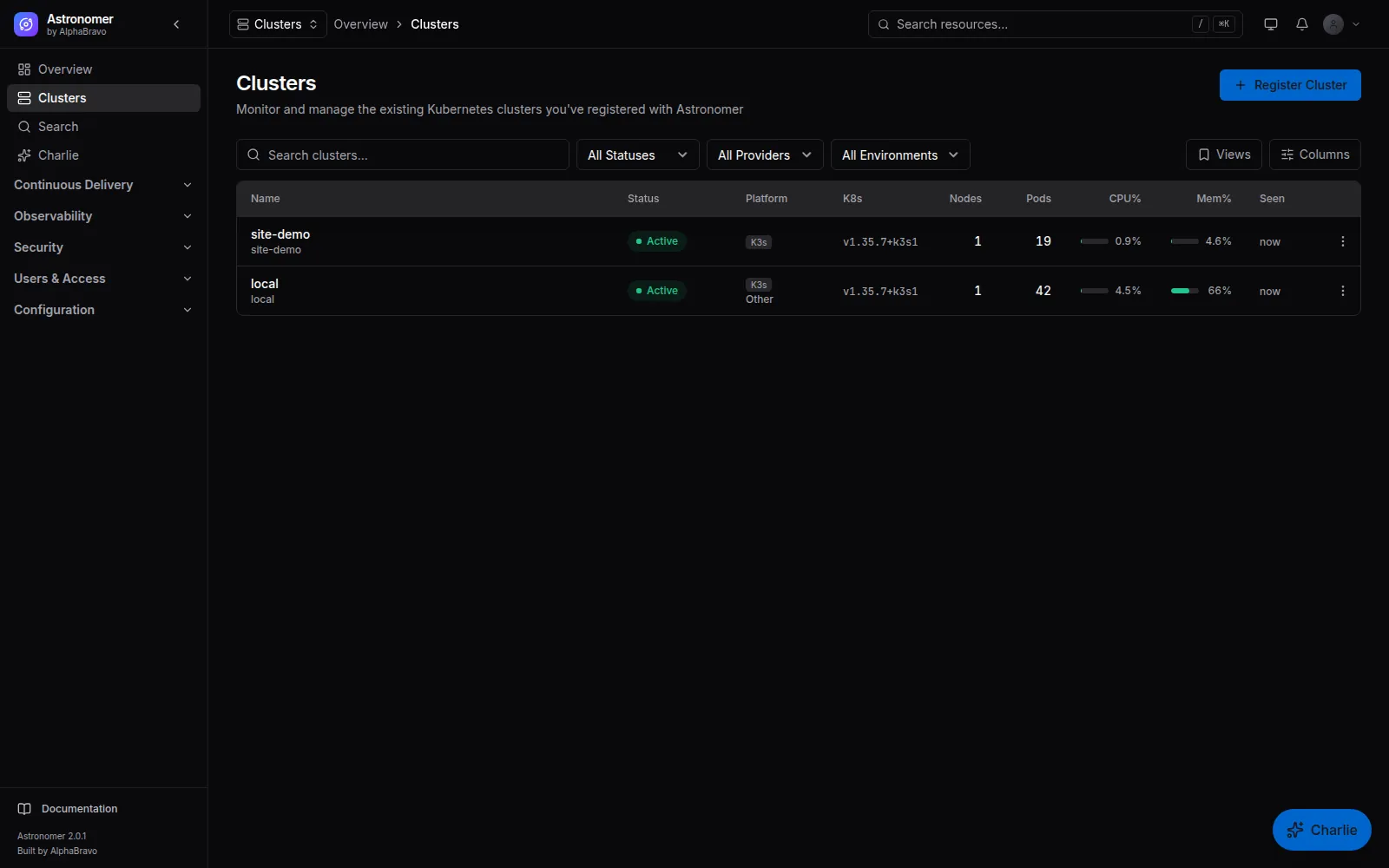
Every adopted cluster in one list, with its connection state, distribution, Kubernetes version, environment, region, provider, labels and projects. Cluster groups organize the fleet by whatever matters to you.
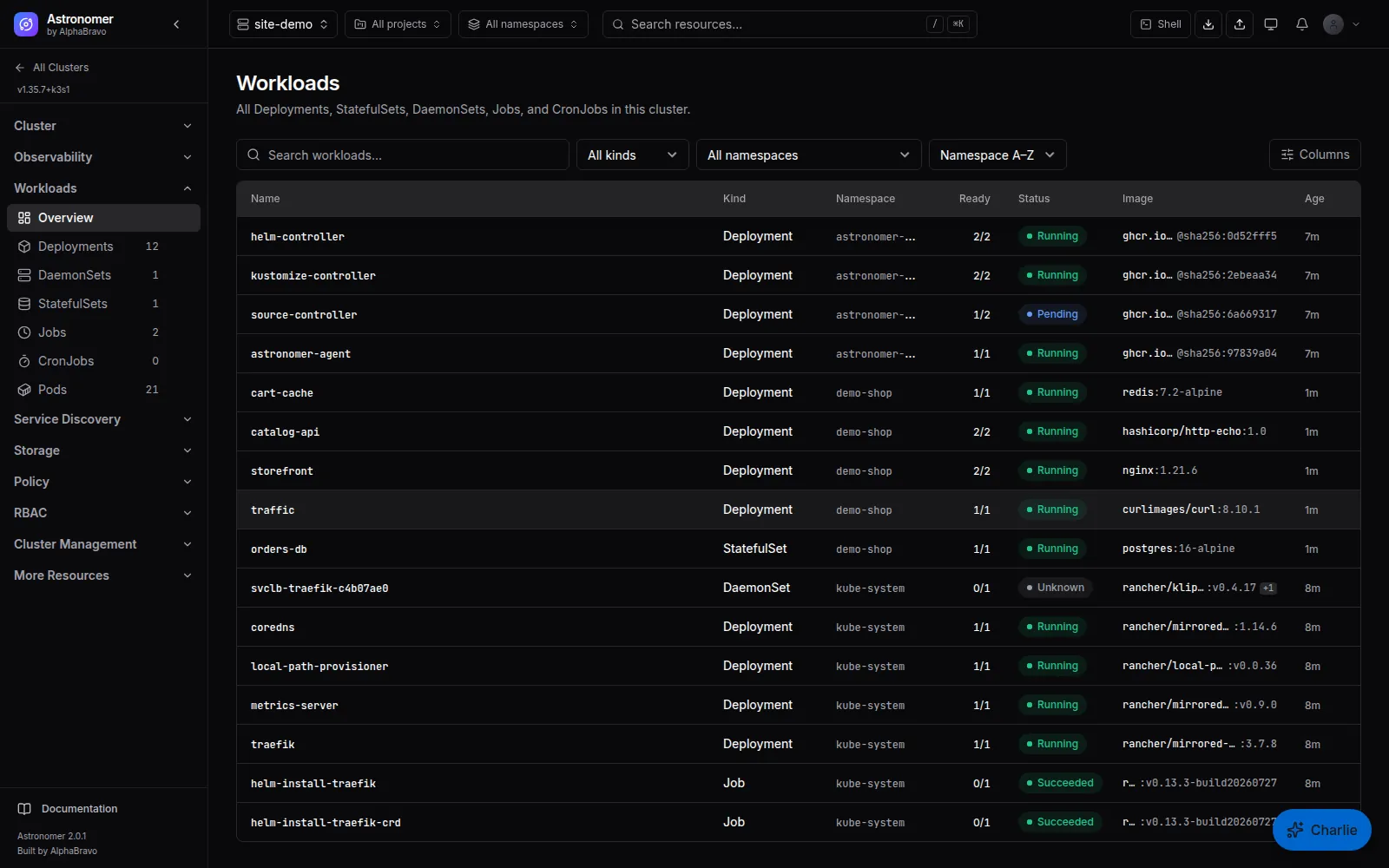
Browse live built-in and custom resources on any cluster: namespaces, nodes, workloads, services, ingresses, Gateway API resources, storage, RBAC objects, network policies, quotas, CRDs and more.
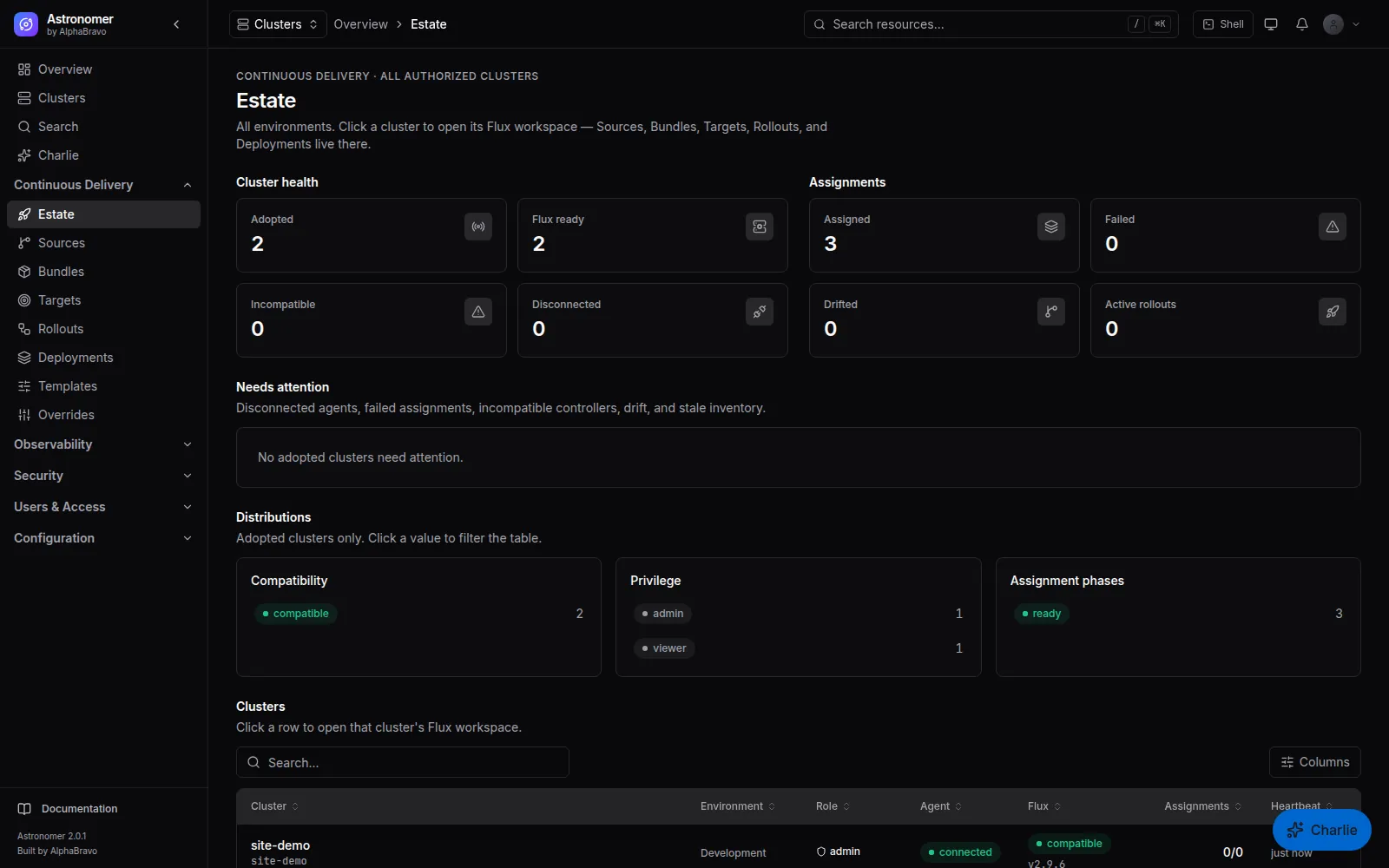
Project-scoped sources, immutable bundle versions, targets that select clusters by label or group, and rollouts with approvals, maintenance windows and failure budgets. Flux reconciles locally on each cluster.
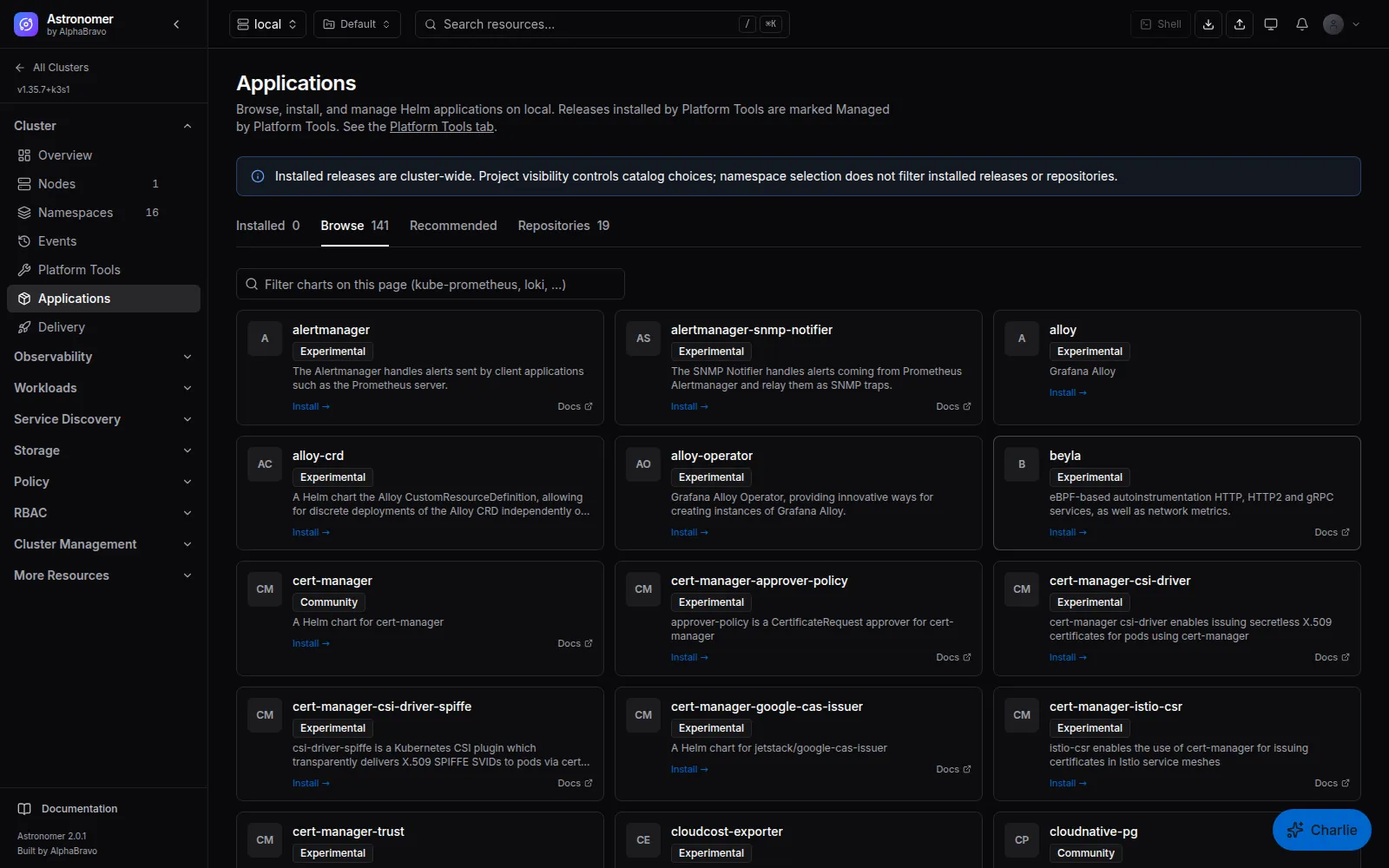
Install Helm charts on a cluster from curated, Astronomer first-party, community and operator-added sources. Installs go through the same delivery path, so Flux owns their lifecycle.
Projects, quotas, global, project, cluster and namespace roles, single sign-on through Dex, SCIM provisioning, TOTP and scoped API tokens. Permissions shape what the console shows.
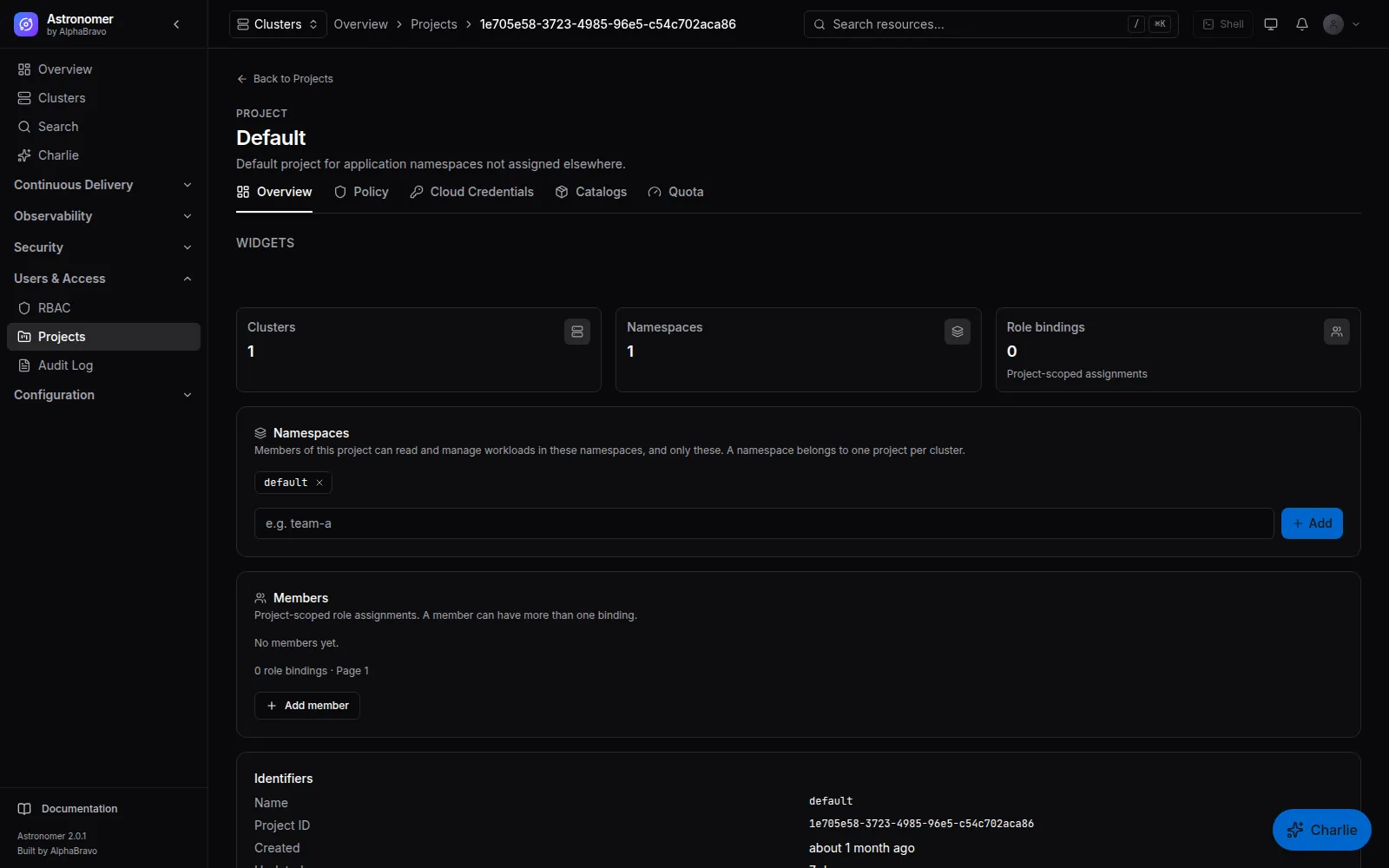
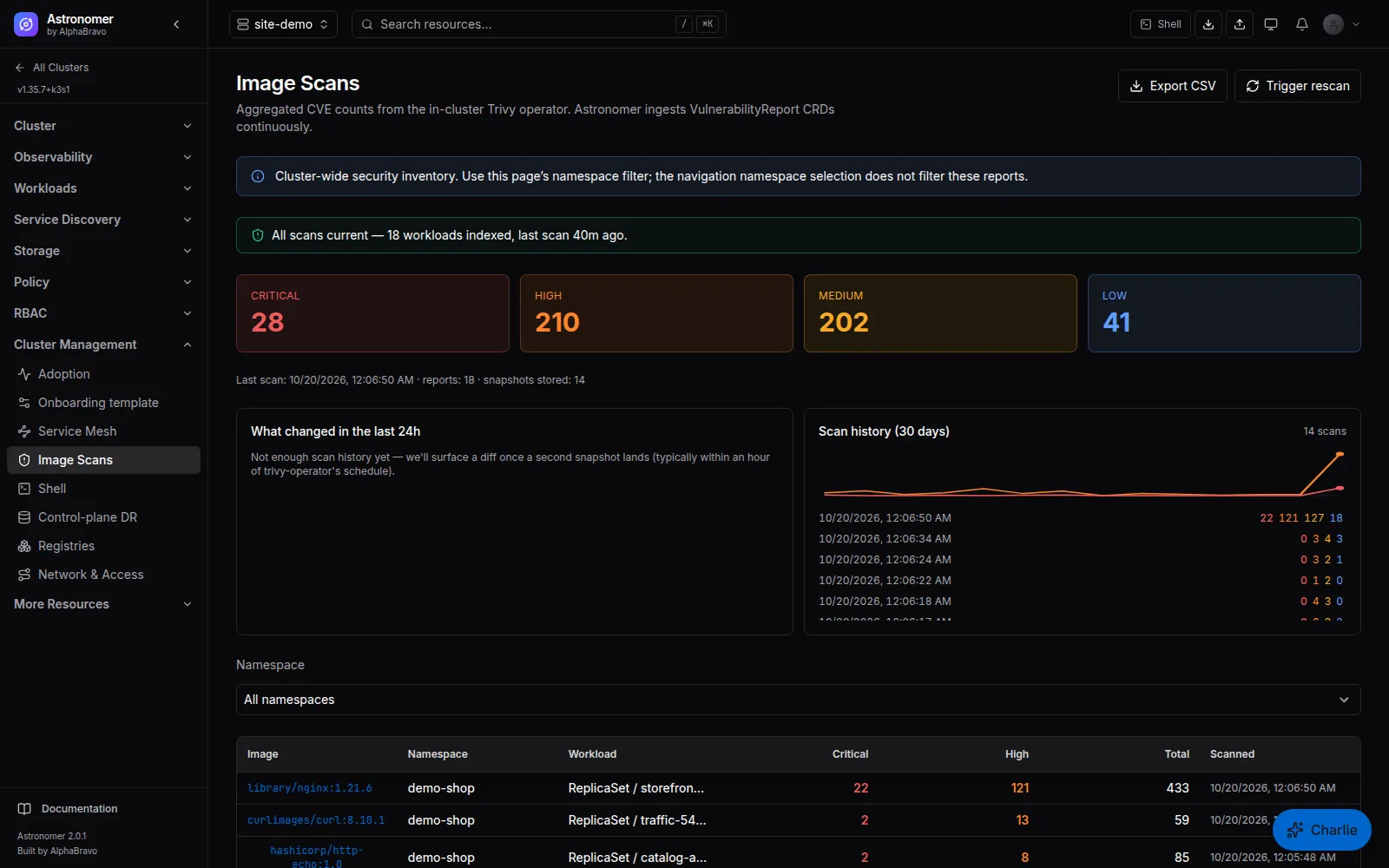
Image vulnerability scans from the in-cluster Trivy Operator, CIS scans, Pod Security Admission templates, Gatekeeper constraints, network policy templates, registry and service-mesh posture.
Per-cluster monitoring stacks, shared Thanos, Alertmanager and Grafana, alert rules with anomaly detection, log pipelines and destinations, SIEM forwarders and outbound webhooks.
Velero-backed cluster snapshots and schedules on member clusters, and management-plane backups to S3-compatible storage with a recorded restore drill.
02 / DURABLE OPERATIONS
Astronomer keeps its intent and history in PostgreSQL: users, roles, audit history, projects, inventory, encrypted credentials and operation records. Work that has been committed but not yet picked up by a worker sits in a durable outbox, so a restart does not lose it.
Operators can see queues, dead letters and the outbox from the console, and long-running actions return a receipt you can follow.
03 / PRODUCT BOUNDARY
Astronomer is not a cluster provisioning product. It does not create clusters, machines or node pools, and it does not drive cloud infrastructure. Use Terraform, Cluster API, a cloud service or your own automation for that, then adopt the result.
It also does not install or emulate Rancher Fleet or Argo CD. Delivery uses Astronomer’s own model on top of local Flux controllers.
No node-pool provisioning and no forced infrastructure workflow.
Managed clusters are reached through an outbound agent connection.
PostgreSQL holds product intent and history; each cluster’s Kubernetes API holds its live objects.
04 / GO DEEPER
Registration, the outbound agent, the explorer, the shell and kubeconfigs.
Fleet & adoptionSources, bundles, placement previews, rollout strategies and the apps catalog.
GitOps deliveryProjects, RBAC, single sign-on, audit, read audit and compliance presets.
Governance & accessImage and CIS scans, Pod Security, Gatekeeper, network policy and secrets.
Security & policyMetrics, alerts, logs, SIEM forwarding, snapshots and management-plane backup.
Observability & recoveryManagement plane, PostgreSQL, the agent and Flux on each cluster.
Architecture05 / FAQ
Yes. The automatic baseline is small: Flux controllers, optional metrics exporters and Trivy image scanning, which you can opt out of. Everything else is a choice from the catalog or your own delivery bundles. #
The current release line supports Kubernetes v1.33, v1.34 and v1.35, latest patch of each. Agents must fall inside a declared compatibility window, and an unknown future agent version is rejected before it is authenticated. #
There is a signed, declarative extension model with governed mounts and a constrained data proxy. It is off by default while the marketplace is incomplete, and arbitrary backend plugins are not supported. #
Astronomer is licensed under the GNU Affero General Public License v3.0 or later. Ask AlphaBravo about access to source and release artifacts during alpha. #
NEXT STEP
Tell AlphaBravo what you run today. We will show you the workflows that matter to your team.