One chart
Install the management plane with an exact chart version. Production values add HA replicas, CloudNativePG, Sentinel-backed Valkey, TLS, NetworkPolicy and backups. Astronomer uses Gateway API for ingress.
ASTRONOMER PRODUCT / ARCHITECTURE
Astronomer splits responsibility on purpose. PostgreSQL holds product intent and history. Each cluster’s Kubernetes API holds its live objects. An outbound agent connects the two, and Flux on each cluster does the reconciling, so a management-plane outage does not stop released work.
Alpha · Kubernetes v1.33–v1.35 · PostgreSQL 16–17 · Flux v2.9.601 / THE SHAPE
Operators use the console, the API or the CLI. The management plane decides and records. Agents in member clusters dial out, receive assignments and report status. Flux on each member cluster applies them.
02 / COMPONENTS
Select a component to see its job, its boundaries and what it depends on.
Go API server and background worker, plus the React operator console. The server serves the API and holds agent connections; the worker runs durable operations and reconciliation. Several replicas can run, and reconciler leadership is held through a PostgreSQL session that is monitored and released if lost.
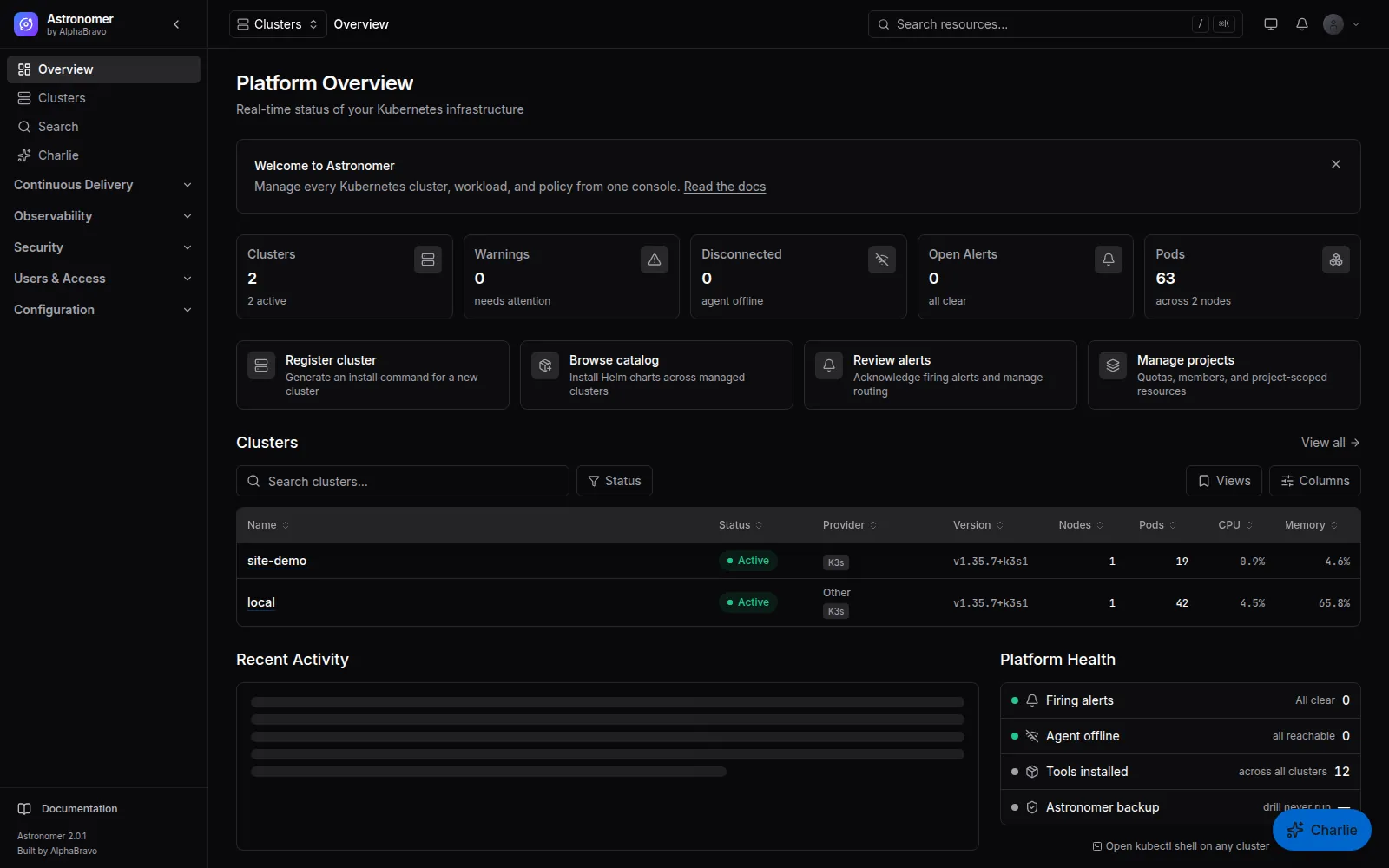
PostgreSQL is the authority for Astronomer’s own records: users, sessions, RBAC, audit history, projects, cluster inventory, encrypted credentials, delivery intent and operation records. Committed work waits in outbox tables, so it survives a worker or queue failure.
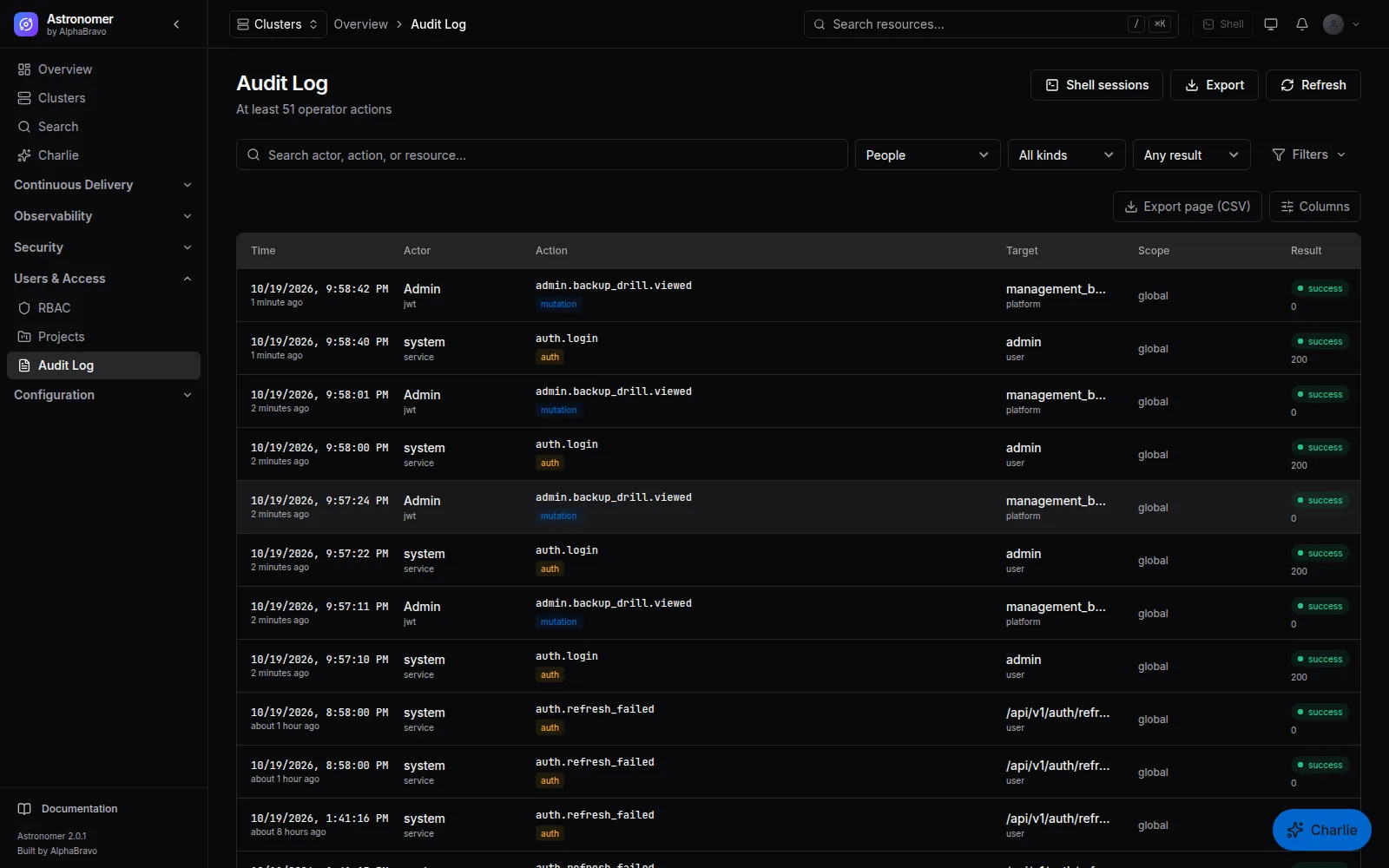
Redis-compatible queues carry background jobs and schedules. They are transport, not the source of truth: losing the queue or restarting a worker cannot erase committed work, and replay is idempotent and bounded.
Runs in each adopted cluster and connects out to the management plane. It carries API proxying, logs, exec, service proxying and health, accepts only delivery assignments bound to its own cluster identity, and materializes a closed set of Flux objects in Astronomer-owned namespaces.
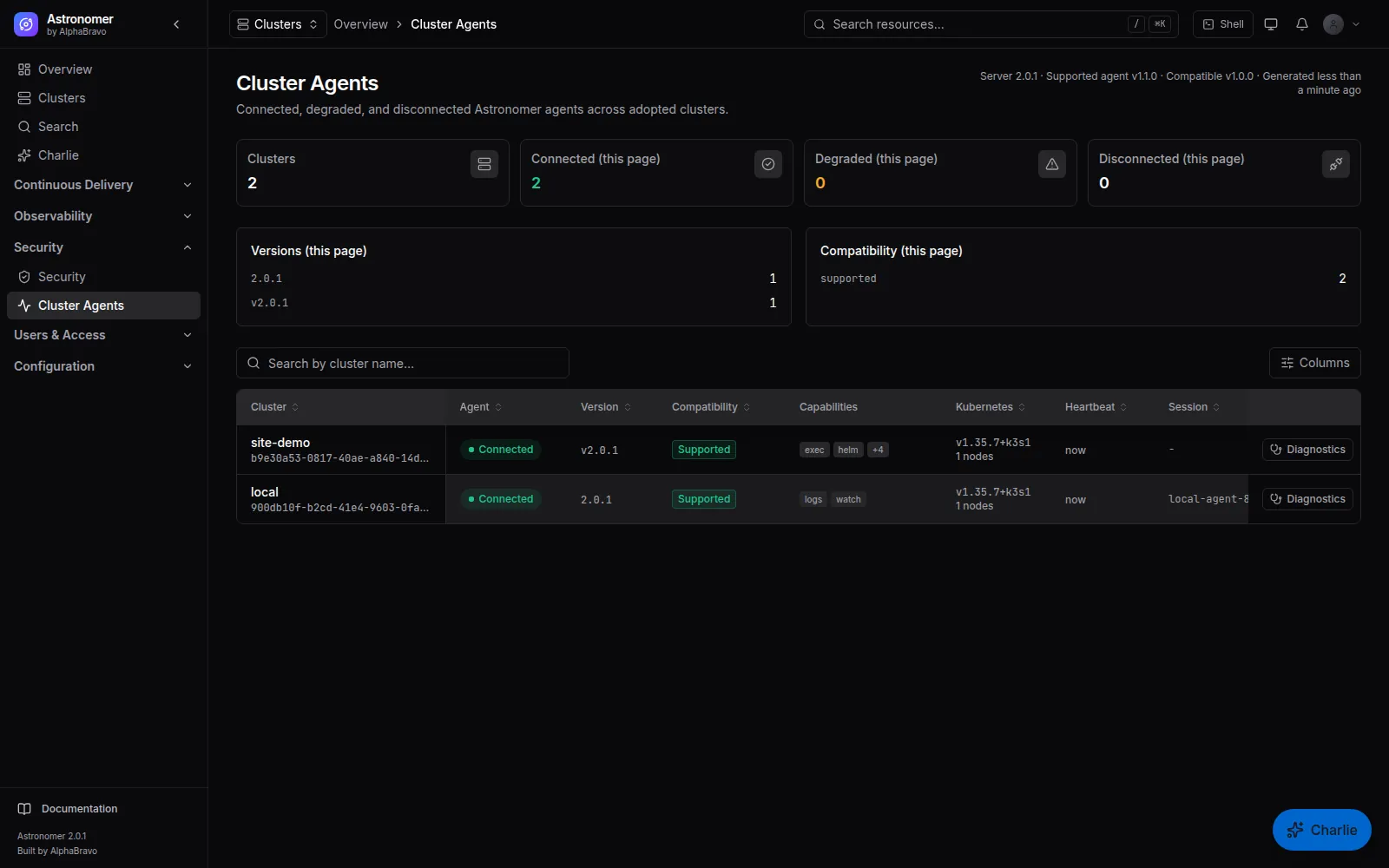
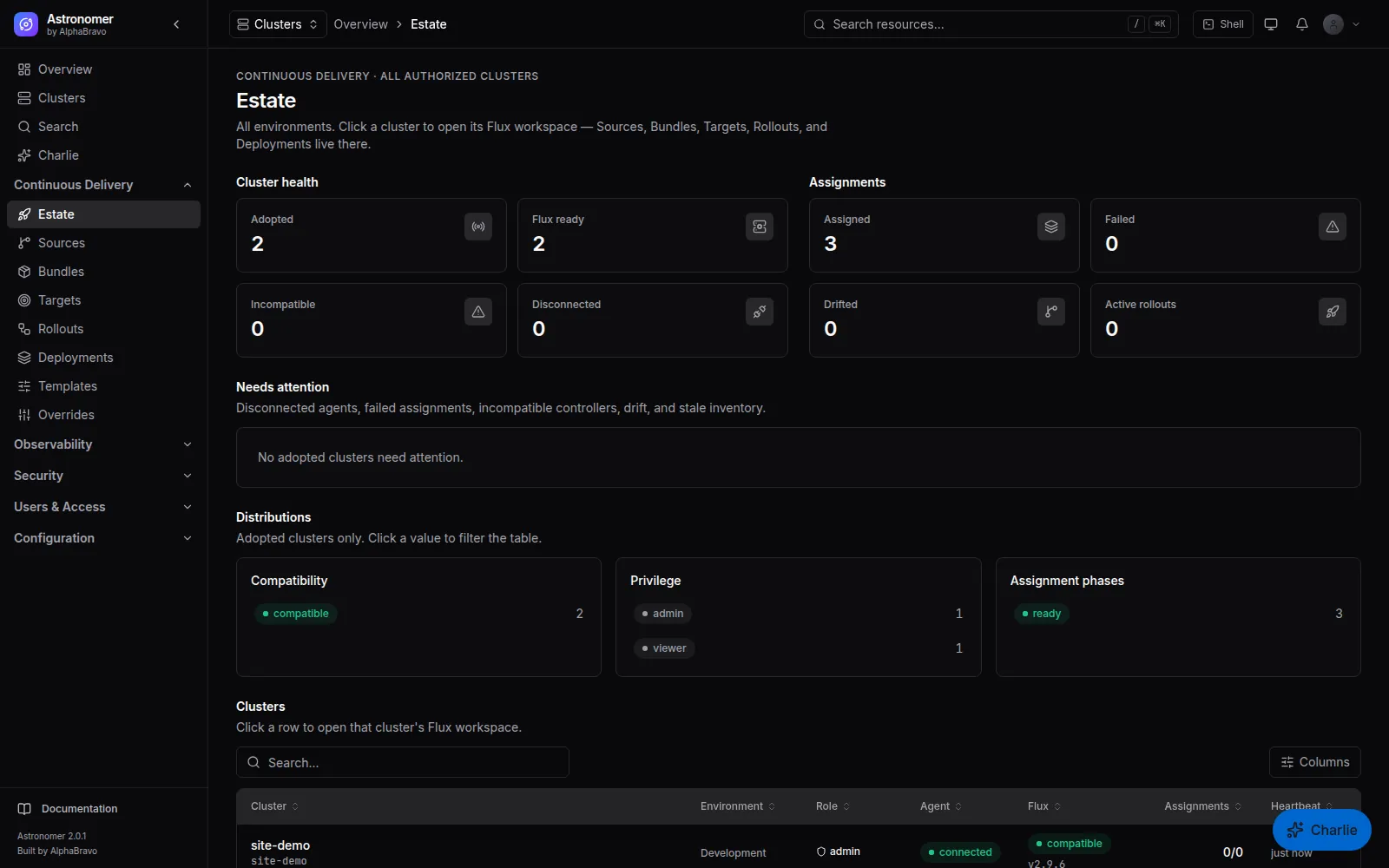
Every adopted cluster runs the release-pinned Flux source, Kustomize and Helm controllers shipped with the Astronomer release. They converge the cluster to the last accepted assignment and keep doing so if the management plane is unavailable.
Single sign-on runs through a bundled Dex, installed and configured from Astronomer. Connectors cover OIDC, Okta, Entra ID, GitHub, GitLab, Bitbucket Cloud, Google, SAML 2.0, LDAP and generic OAuth.
03 / WHO OWNS WHAT
This split is why Astronomer can keep history and audit without pretending PostgreSQL replaces etcd, or that Flux is an account database.
| State | Authority | Rule |
|---|---|---|
| Users, RBAC, audit, projects, inventory, credentials, operations | PostgreSQL | Durable intent and history; secrets encrypted, hashed or referenced externally |
| Background execution | PostgreSQL outbox, carried by the queue | Queue loss or a worker restart cannot erase committed work |
| Live Kubernetes objects | Each member cluster’s API | Read live; edits use server-side apply without forcing ownership |
| Delivery convergence | Flux on each member cluster | Astronomer supplies desired objects and observes conditions |
| Optional CRD intent | Cluster, Project and AgentProfile resources | UI and API cannot silently overwrite CRD-owned fields |
04 / INTERFACES
The console, the astro CLI and generated TypeScript and Go clients all use the same public API, described by an OpenAPI contract that covers every mounted route. Long-running changes return durable receipts with idempotency, so a retry does not repeat the work.
With CRDs enabled, management.astronomer.io/v1alpha1 exposes Cluster, Project and AgentProfile intent for kubectl apply and GitOps workflows, with status conditions. The CRDs are an intent surface, not a mirror of every database object.
astro login
astro cluster list
astro cluster-agent list
astro delivery target preview
astro docs   # open the live API reference
05 / INSTALL AND AIR GAP
Install the management plane with an exact chart version. Production values add HA replicas, CloudNativePG, Sentinel-backed Valkey, TLS, NetworkPolicy and backups. Astronomer uses Gateway API for ingress.
The chart ships no key material. Generate the signing and encryption keys once and keep them; back them up separately from the database.
A release is one compatibility unit: chart, images, agent, Flux distribution and built-in bundles. Verify the signed release manifest, mirror every listed image to your private registry and install with no public registry access.
A release supports upgrades across its documented schema range. Read the release’s migration notes and back up the database and encryption key before upgrading.
NEXT STEP
Bring your cluster layout, network boundaries and identity provider. We will map them to Astronomer’s components.